This is a snippet from my book, to be released in early 2027.
My booking was not what most people would consider safe and secure. Some might have called it irresponsible. In reality, I had little more than a promise of a place to stay. Then again, I remembered leaving my country once for a month without arranging accommodation and without enough money for a hotel. That situation had resolved itself within a few hours of arrival. Why should Cuba be any different, especially when I already had a few local connections I could call upon in an emergency?
My only dislike in this situation is that if I were going to share my living space, I would have preferred a Cuban family. I hadn’t crossed the Atlantic to spend my evenings with fellow Europeans. I temporarily left Europe because I needed something else. But here I am, adapting to what comes my way.
The apartment occupies the entire ground floor of the building, with a small yard, open doors and glassless windows with ancient-looking wooden shutters. It has a separate entrance, so the occupants of the upper floors have no access to it. As it turns out, my room is someone else’s room. My host has given it over to me for the duration of my stay. It is packed with decades of belongings. The wardrobe and drawers are full, leaving me no chance to unpack my suitcase, though I am far too tired to worry about that now. After thanking everyone for the warm welcome and taking a much-needed shower, I am finally ready for my very first night in Havana. Even if I spend it indoors, it is difficult not to feel the significance of the moment.
The night is chilly, and I only have a sheet to cover myself with. It is not enough, so I rummage through my suitcase in search of something warm to put on. When I tell my flatmates the next morning that I had been cold, they look at me as if I were nuts. It felt strange to me too, but what can I do? I really was cold on my first night in Cuba—a country where I had been warned that life feels like living inside a volcano all year round. Apparently, that is not the case.
I wake up early and take a tour of the apartment before anyone comes out of their rooms. The ceilings are even higher than those in my apartment in Budapest’s inner city, where they reach almost four metres. The architecture feels familiar. Many of the buildings I caught glimpses of on the way here reminded me of Budapest as I remember it from childhood, before renovations transformed much of the city. Their faded facades, peeling paint and worn appearance brought back memories of a time when parts of Budapest looked far rougher than they do today. One major difference, however, is the reason for their decline. In Budapest, wartime shelling left lasting scars on the city’s architecture. To this day, many buildings remain unrenovated, their walls still bearing bullet holes from the Siege of Budapest during World War II and the Hungarian Revolution of 1956. In Havana, decades of economic crisis and neglect have led to the deterioration of countless beautiful and valuable buildings.
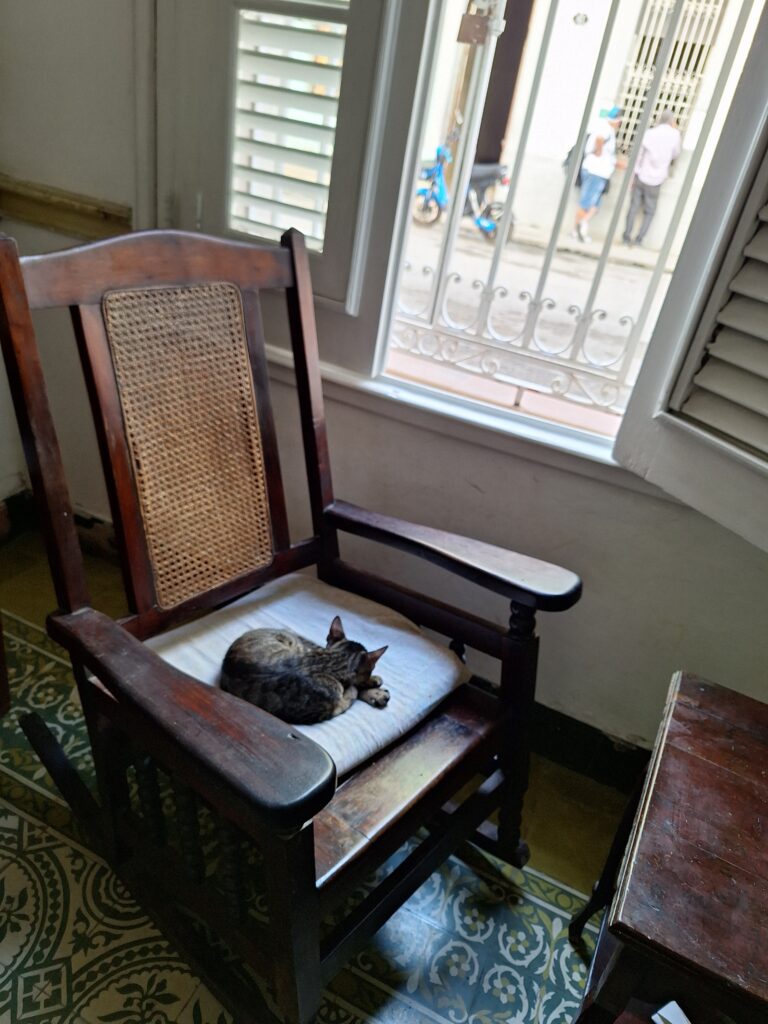
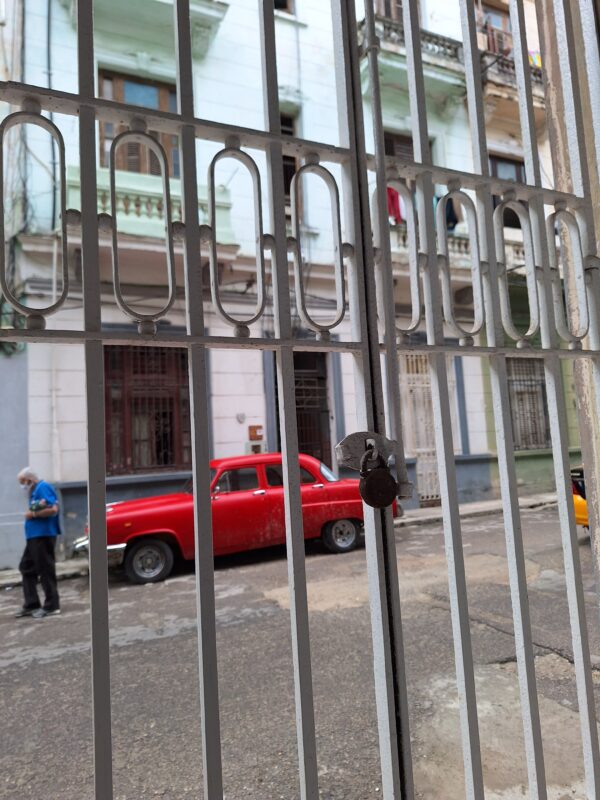
I like the living room. It retains the atmosphere of another era. In a wooden rocking chair beside the tall windows that open directly onto the street, a cat is purring peacefully, curled into itself as if there were no worries in the world. The tiles on the floor remind me of my grandmother’s house. The pattern is different, but the quality and style are the same. They seem as old as the building itself. Through the windows, I peek out onto the street. Kids are already outside, and I see a few people going about their business. One of those classic cars, painted bright red, is parked opposite, beneath the barred windows. Maybe a Chevrolet from the 1950s.
I walk to the kitchen through the open courtyard, where a few potted plants are doing their best to stay alive in the enclosed space. Strangely, there are several more floors above us, but the rest of the building’s inhabitants cannot access this area. We are separated. I don’t have the sense of connection I have read and heard so much about: neighbours becoming an extension of your family, the lives of everyone in the building so intertwined.
The kitchen mirrors the image of Cuba that I have seen in countless promotional photographs. There is nothing extraordinary about it. Everything is old. Nothing matches. But that is probably why such places leave an impression on the outsider: as if this mishmash of objects were a distinctly Cuban style in itself.
On one wall hangs a collage made from pages of Granma, the official newspaper of the Central Committee of the Communist Party of Cuba. It portrays a female figure, almost stylised, sitting in a chair with a cat curled around her shoulders. Her exaggerated features remind me of carved African masks. The broad forehead is highlighted with white paint; the eyes are large and wide, while the lips are small in comparison with the rest of the face. She appears to be a white woman. Or perhaps she represents the many influences that have shaped the country over the centuries. A small cup of coffee sits on a little table beside her, next to colourful flowers that appear to be made from old buttons. The woman is opening a box resting in her lap, but the artist does not reveal its contents. Pandora’s box, perhaps? The thought crosses my mind, probably as a way of counterbalancing the cliché I sense in the painting. It portrays what many would consider the stereotype of feminine modesty. Despite my slight reservations, I find it beautiful. It radiates harmony. “Para mi querido amigo con amor.” says the dedication. It may have been a gift from the artist to my host. I may ask about it later.