This is a snippet from my book, to be released in early 2027.
On my right I notice a strange cliff full of hanging somethings. There is a sign asking hikers not to make noise and disturb the wasp colony. A wasp colony? Occupying this giant cliff? Where’s the way back? My curiosity wins and I go closer to see this curious formation. The cliffside is so extensive that I can’t even tell how far it stretches or how high it is, and a big part of it is hidden by the canopy. What I can see is covered with hundreds of strange little drops. As if the stone was crying. On a closer look, I see they are individual nests. How individual their lives are allowed to be, I don’t know. If they belong to one colony, then they are probably one big family that works together and lives for each other, much like life in the individual hives I know.
There is no information provided beyond the warning sign. Which is in Spanish only. I guess it would be useful to add an English sign here for those who are more concerned about wasp stings. I don’t see any of them flying around, though. It’s quiet here, no trace of the little warriors. Too quiet, maybe! They build smartly because every one of these drops seems to be out of human reach. Most wasps don’t store honey; they only drink nectar for energy, but I guess they don’t want their homes to be destroyed or taken home as souvenirs. They are predators and love their protein. Which I am, too.
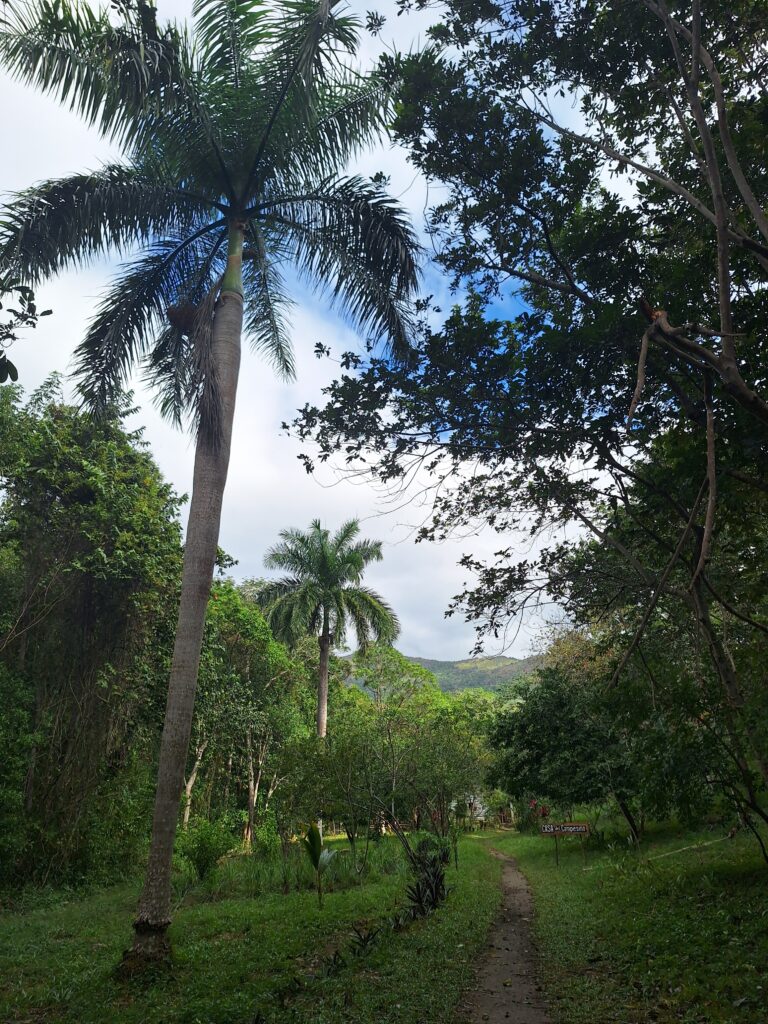
Five minutes later I find myself in a very different environment. This is what comes to my mind when I think of a tropical forest. It’s harsh green while a few minutes earlier I was surrounded by lots of brown and lighter colours, rocks and ravines. I am walking on flat ground now, with proud palm trees around me and the sunlit mountain range clearly visible in the distance. I follow a well-beaten path when I notice a cabaña on my left. There are small patches of plants or herbs around it. The cabaña could easily be two hundred years old, and it could have been built solely as a tourist attraction, but I prefer to think it’s left over from another era. That’s more romantic, isn’t that? A small, painless glimpse into the past. A man steps out of the house and points me in the direction the rest of my group went. I haven’t seen anyone in front of me for the last hour.
“Estoy sola,” I tell him. “¡Buenos días! ¿Puedo pasar?”
“¡Por supuesto!”
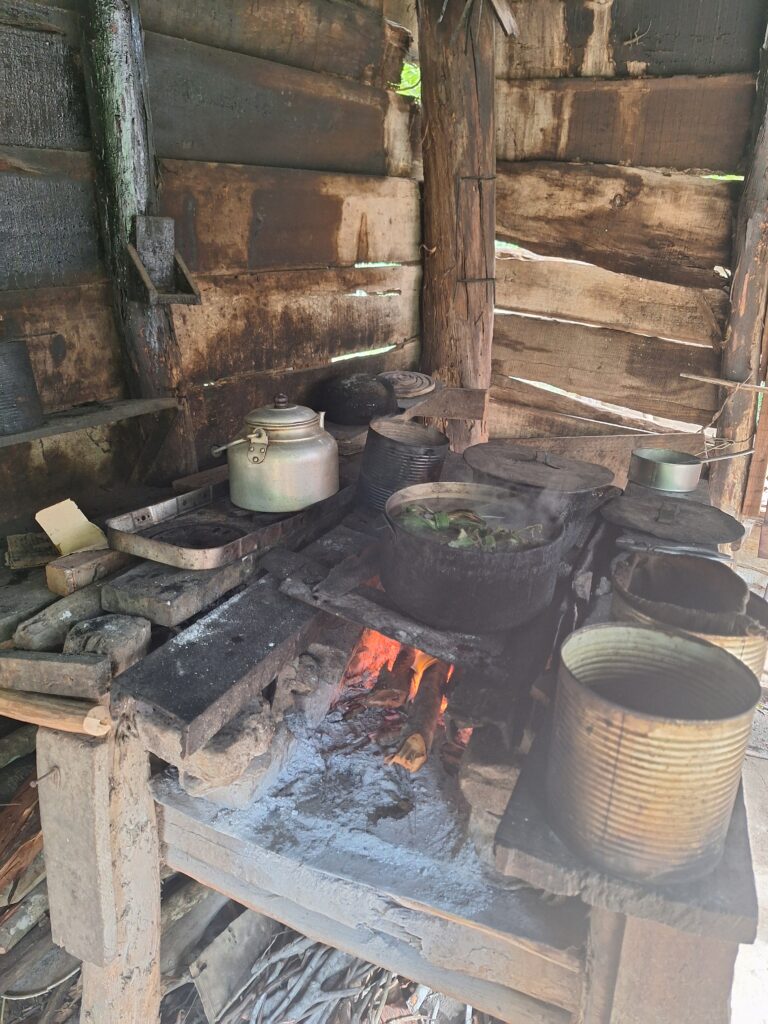
In the hut, the first thing I see is a rudimentary open stove, interestingly made of wood. A few stones protect the wooden structure from the flames, but they still look too close to the flammable material. By magic, it looks intact. On the stove, there is an old blackened cauldron with what looks like herbs being cooked in it. My host says he makes a concoction used for stomach issues. He works for the park and collects plants in the forests to make medicines.
I see a bunch of fruit hanging from the roof and ask the man about it. It looks like the fruit of a palm tree, although its stem reminds me of some kind of creeper. All in all, I have no idea what it is. He tells me the name, piña de ratón. Pineapple of the mouse. The elongated, slightly pointed, pod-like fruits grow in clusters. Maybe the pointed tip is what made someone think of a mouse. Its scientific name may be less entertaining, but I won’t go into that at the moment. They have a brownish-orange colour and already look dried out in the sun. He asks if I want to taste it. How would I not? Usually I willingly run into my fate. But the medication is close by, so I am not too worried.
He peels the fruit for me. It has a thick outer layer, but inside it’s soft and tastes citrusy. More like a lemon than an orange. My taste buds are happy, so am I. The man says I can spit it out if I don’t like it. Why would I? I like it. Not bad at all.
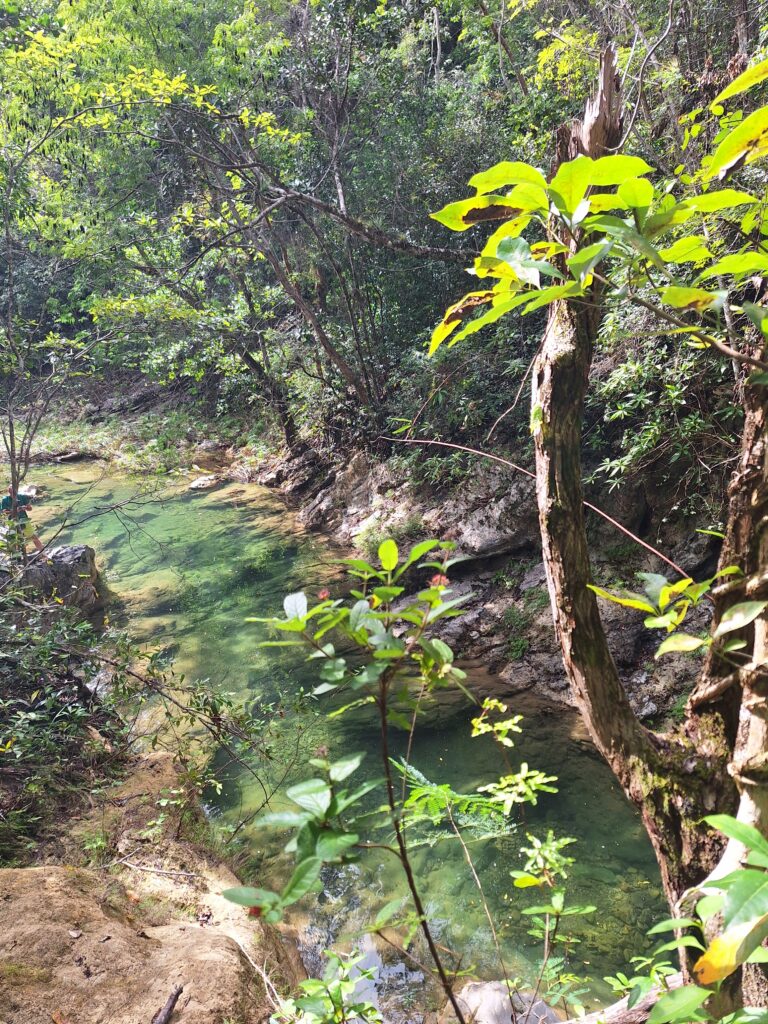
I feel good after the brief encounter, and not even the river can stop me from continuing my journey. Well, it’s more like a stream but I have to cross it nonetheless. A rope stretched over the water helps me maintain my balance while I jump from rock to rock like a trained mountain goat. The stream widens when I walk on and again I can admire the various shadows of green playing on its surface. It must be Río Javira, the river that forms the waterfall.
I reach my destination in less than an hour after entering the park and see the group the man at the hut told me about. It was a brief but rich hike, and I would gladly jump into the water to cool down if I had the courage. It’s crowded. The plunge pool and the cliffs have turned into a photo studio, with people posing in and out of the water to get the perfect shot for social media. I sit down on a free rock and just try to take in what I see. The beauty around me is unlikely. The last thing I would want to take a photo of here is myself, the smallest part of the whole.
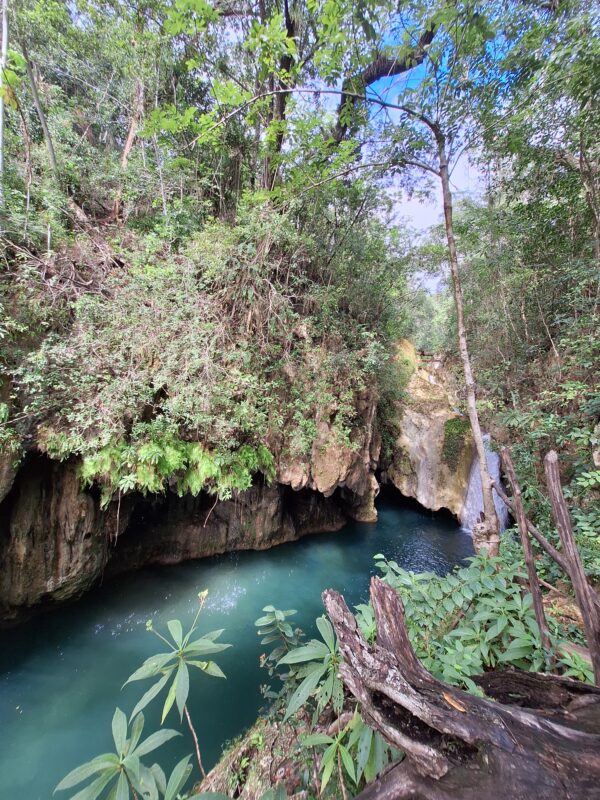
The water falls from the cliff in heavy streams into a turquoise pool that’s surrounded by cliffs like a horseshoe, breaking the peaceful silence. The cliffs are partially covered by young trees and shrubs, providing shade above the water, which then flows on calmly in its narrow bed. As the rays of the sun break over the leaves and mix with the blue of the sky mirrored in the water, they create a special kind of golden-green halo around the river. There are caves beyond the waterfall, but I see no one swimming in them and neither do I. Next time, this too, I promise myself.