This is a snippet from my book, to be released in early 2027.
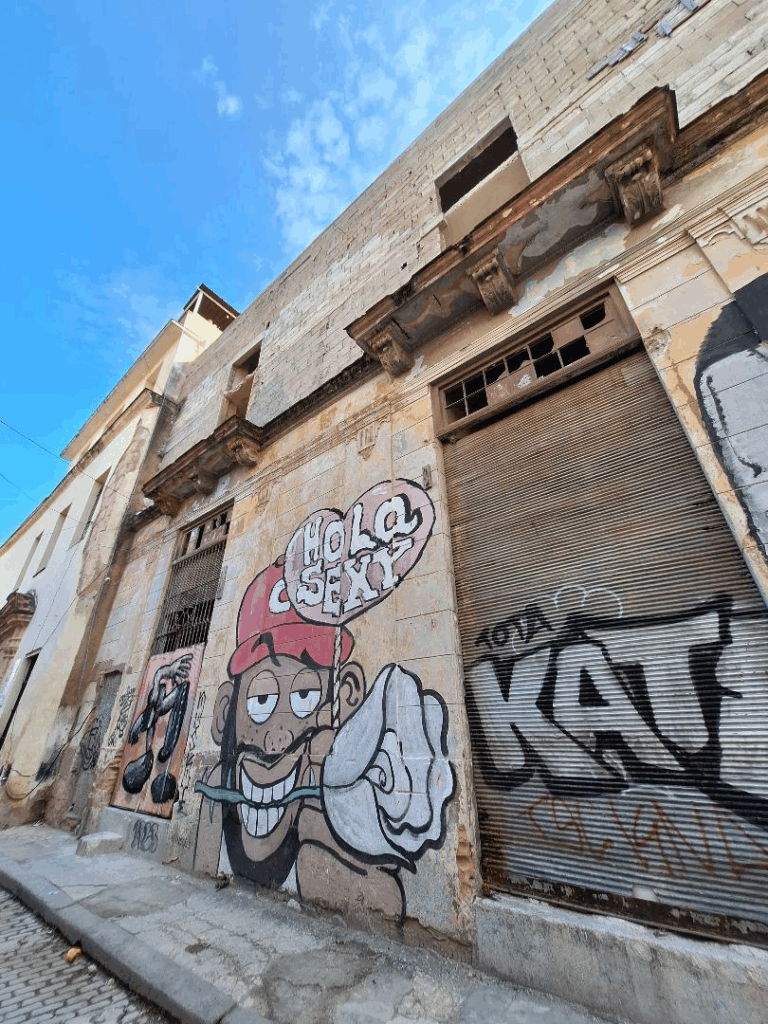
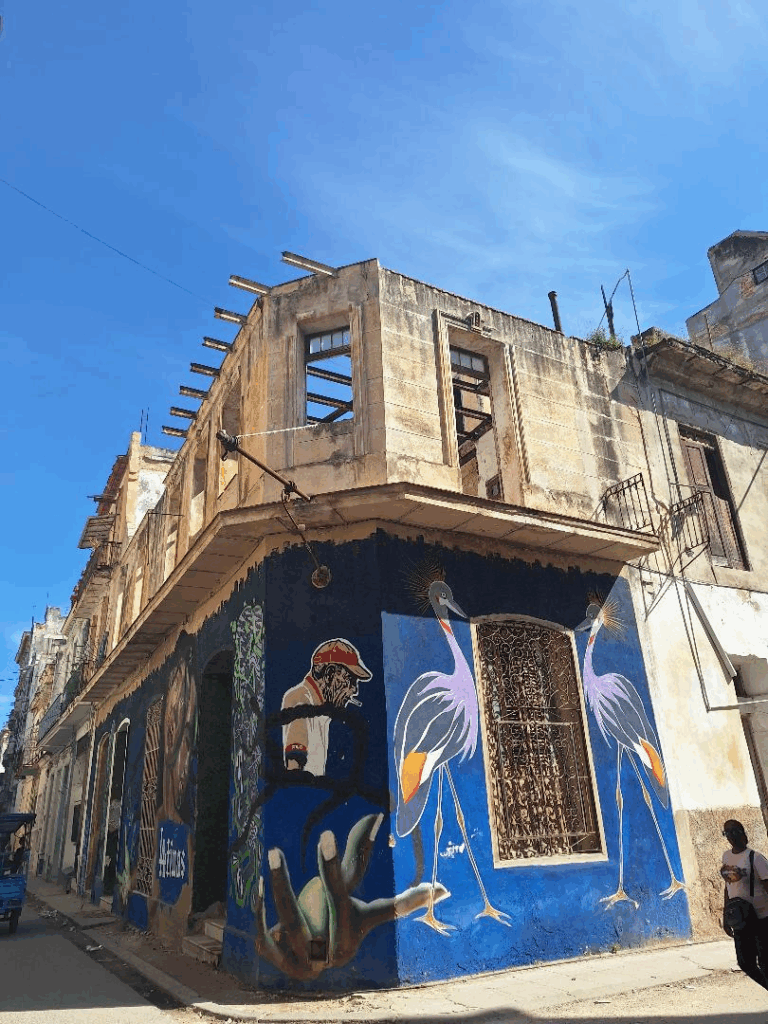
Street art, wherever I look. Many portray Afro-Cuban figures, while others are non-figurative or surrealist, and most are painted on crumbling buildings or unused roller shutters. The effort put into creating something so temporary is admirable. Some of the walls look like they could collapse at any minute, taking with them the blend of colours, styles and influences the artists share with us. Havana is a haven for street artists and for those who appreciate it. Graffiti of all kinds covers many abandoned buildings, while businesses consciously use them to promote what they believe in or simply to attract attention. People even actively encourage artists to decorate their walls. What’s not so obvious at first sight is that not all are created by Cuban-born artists. There are paintings by French, American, Mexican, Australian, Spanish and other artists. Even if they sign their work, the uninitiated will not know who the strange nicknames belong to. Like 2+2=5. It’s not only a slogan, but the tag of a muralist who is actually Cuban, but the name could belong to anyone.
In this area, everything feels heightened. The shapes and sizes are exaggerated, the messages critical of the regime are obvious. It’s especially bold in a city where art is often censored. I am in what is known as the Distrito de Arte San Isidro. It consists only of a few streets, but it became well-known in the art world far beyond the country. I stop in front of a building, not sure I am at the right address. I only see a locked shutter with no information about whether it’s the gallery I’m looking for. My map says it is. A woman sitting on the step of the building behind me, whom I hadn’t noticed until then, asks if I am looking for the restaurant. There is a posh one too, here, I know about that, but I came to see Galería Taller Gorría. “Están cerrados. Es domingo.” Great. Not even weeks are enough to discover a city if we don’t know what we are doing. I didn’t find information regarding their opening times so I just gave it a chance. While on holiday, Sundays are no different from Tuesdays, but I can’t say so easily, ah, next time, as I have only a couple of days left of my stay.
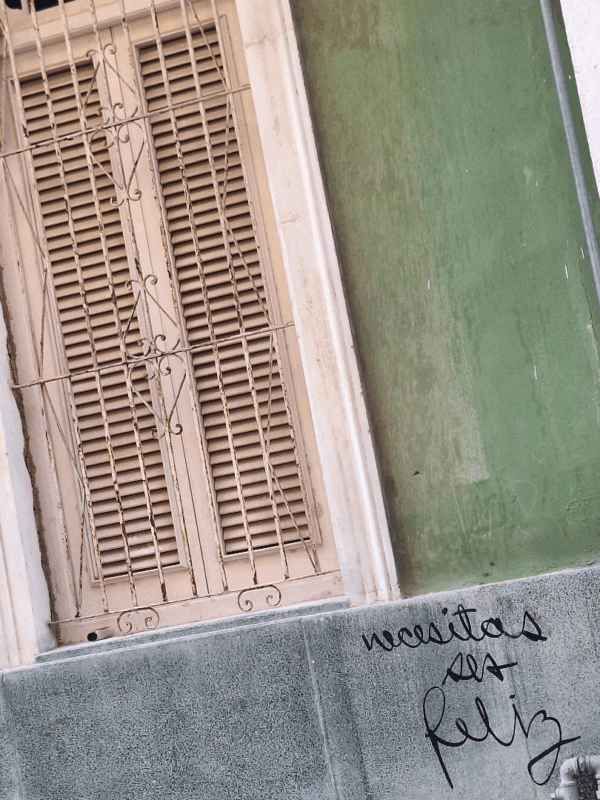
It’s a creative hub but the streets I am walking now look like the most deprived I have seen so far in Havana. They are almost completely empty and the atmosphere is depressing. I wander aimlessly, noticing the writing I have seen on many walls in Havana, usually in beautiful handwriting. Necesitas ser feliz. The slogan comes from a young artist who may believe that this brief command has the power to pull people out of the despair that surrounds them. It has an effect, no doubt. When I first saw it, the contrast between being asked to be happy and the visible material collapse around it was almost offensive, but it can probably provide some kind of escape when the mind can relax for a moment and re-establish hope. Movimiento San Isidro is closely connected to the area. They are artists, musicians, writers, academics and journalists who came together in 2018 in response to increasing censorship of artistic expression. They are people many of us might have seen in the news, arrested and sentenced, and even expelled from the country.
Crossing Calle Desamparados, I find the largest craft market in Havana on Avenida del Puerto, in a 19th-century warehouse. They are open on Sunday! Inside, a maze of stalls greets me beneath the iron structure, selling everything that falls under arts and crafts. I mostly see vendors. Only a few tourists are walking between the rows of stalls. The vendors are very persuasive and don’t give up easily. Neither do I. What attracts my attention are the paintings. There are so many that it would be difficult to pick one. They all look different, but every canvas is filled with the scenes and images that first come to mind when we think of Cuba. They are colourful, carefree, and complex. It’s tourist land. I know that I wouldn’t buy anything. I have my small painting by an artist I personally met, and that’s enough. I have travelled enough to know that I can’t take home anything that is really important to me and truly represents a country. I have objects from various places in the world, but they all came with memories. I don’t buy from tourist markets where meaning is hard to find.
Crossing the avenue again on my way back to Old Havana, I see a few children sitting on the corner in front of a closed shop with an older woman. I don’t pay much attention. One of the boys, barefoot and wearing only shorts, makes a move towards me but then stops. He shouts aggressively at me, “Pesos!” When I don’t react, he tries “Money! Dinero!” He can’t be older than ten. The woman says nothing, just watches.
After a walk on Avenida de Bélgica on the western edge of Old Havana, I am ready for a late lunch. I find a restaurant that boasts “Aquí jamás estuvo Hemingway.” I like them instantly. In a city where the name of Hemingway means business, it’s refreshing to read the mild sarcasm about his absence. I walk up to the terrace and choose ropa vieja. I think I kind of want to overwrite my previous experience with the dish, so it won’t remind me forever of being scammed and looked down on. The portion is small, it’s a first for me, but the service is kind and I am grateful. I look out over Plaza del Cristo, where local vendors sell their stuff and people gather on benches in the shade of trees. I decide I want dessert and walk towards Plaza Vieja, hoping I find something on the way. Another square, another reason to keep walking and seeing. There is music on the square. I sit down in the café closest to the sound. They only have ice cream and not many flavours, so I pick what they suggest. Whatever I get, it’s made with alcohol. It’s delicious though. Two scoops in a glass cup. They taste of vanilla and stracciatella, both with rum. What else? I don’t hear the music too well, but I hear enough to appreciate the moment. I’m far from the shouting boy now. It’s one of the best-maintained plazas in Havana, but there are still very few people around. The sun is resting on the terraces of the buildings, slowly giving way to a night when the tourists will probably fill the square and, hopefully, chase away some of the hunger, at last.